Break Free From the Hidden Habit That Keeps You Stuck in Overeating
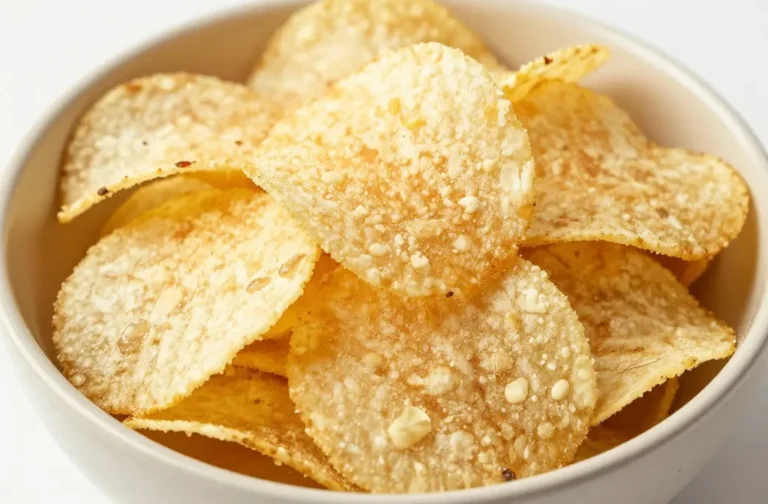
You keep promising yourself you’ll “start fresh on Monday,” but somehow you wind up elbows-deep in a family-sized bag of chips on Thursday night. You’re not broken. You’re not weak. But you might be stuck in a sneaky loop that no one warns you about. Let’s name it, drag it into the light, and ditch it together.
FREE 7-Day Easy Dinner Reset
Get 7 healthy, family-friendly dinners complete with recipes and simple meal plans delivered straight to your inbox.
The Hidden Habit: Micro-Checks That Hijack Your Brain
You know that quick peek into the pantry you do when you’re bored? Or the way you “just check” the fridge to see what’s there? Those “micro-checks” seem harmless, but they train your brain to cue eating without hunger.
Every glance becomes a suggestion. Every suggestion becomes a craving. And cravings don’t negotiate—they demand.
Why Micro-Checks Stick
– They reward you fast: Your brain loves quick dopamine hits.
– They become automatic: The more you do it, the less you notice.
– They blur hunger signals: You confuse curiosity with appetite.
Bottom line: Micro-checks aren’t just a quirk. They’re a habit loop that keeps overeating on repeat.
How the Habit Loop Runs the Show

You don’t just “eat too much.” You follow a loop your brain set up to save energy:
1) Trigger: Boredom, stress, or just walking into the kitchen.
2) Routine: Open the fridge/pantry, scan for something.
3) Reward: A nibble, a scroll, a distraction—whatever soothes.
FYI: You can’t out-discipline a loop. You replace it.
Common Triggers You’re Overlooking
– Walking past your kitchen between Zoom calls
– Finishing a task and wanting a “mini prize”
– Feeling meh and wanting a mood upgrade
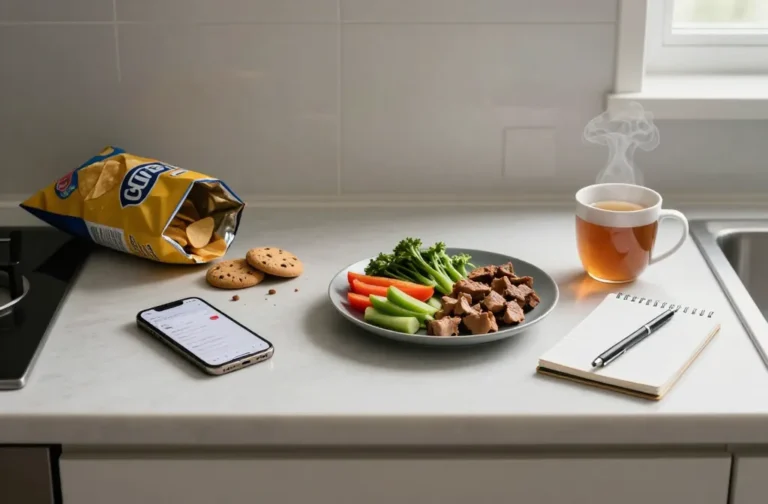
– Seeing snacks on the counter (visual triggers are ruthless)
The Fix Isn’t “More Willpower.” It’s Fewer Decisions
Willpower burns out fast. Systems don’t. Make the next right choice absurdly easy.
Try these low-effort swaps:
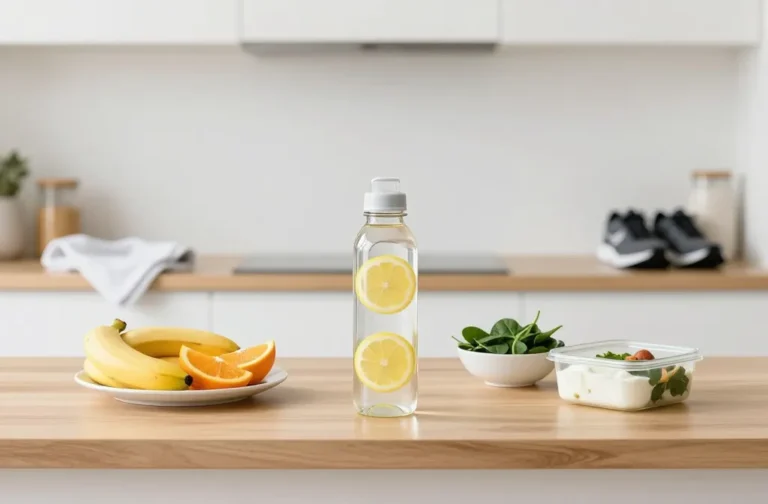
– Move snacks out of sight. Duh, but it works. Put them in opaque bins or a high cabinet.
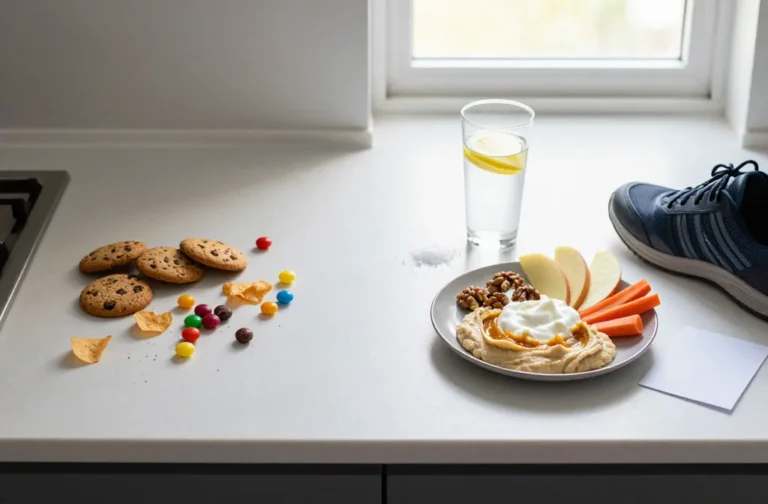
– Put protein-forward snacks at eye level: yogurt cups, string cheese, hummus, boiled eggs, edamame.
– Make “non-food checks” your go-to: water bottle, gum, or a 2-minute stretch when you wander to the kitchen.
Create a Kitchen Boundary
– Close the kitchen for 2-3 hours at set times (example: 2–5 pm).
– Use a visual cue: a sticky note that says “Hungry or Habit?” on the fridge.
– Keep a “craving pad” on the counter. Write down the craving and a time. If you still want it in 20 minutes, have it mindfully.
IMO: If it feels too simple, you’re on the right track.
Rebuild Real Hunger Cues

If micro-checks scrambled your hunger signals, let’s recalibrate.
– Use the 1–10 hunger scale before eating. Eat between 3–7 when possible.
– Add 20–30g protein to your first meal. It steadies appetite all day.
– Pair carbs with fat or protein to slow absorption. Banana + peanut butter > banana solo.
– Drink water first, wait five minutes. Thirst loves to cosplay as hunger.
A 20-Second Pause That Works
Before you open anything:
– Ask: What emotion is here?
– Rate hunger 1–10.
– Decide: Eat a proper snack, drink water, or change scenes (go outside for 2 minutes).
Yes, it’s annoyingly simple. Also yes, it’s extremely effective.
Snack Like You Mean It (Not Like You’re Sneaking It)
Secret nibbling feels fun, but it keeps overeating alive. Plan tiny, satisfying snacks and eat them like a grown-up.
Snack formulas that hit:
– Apple + 2 tbsp peanut butter
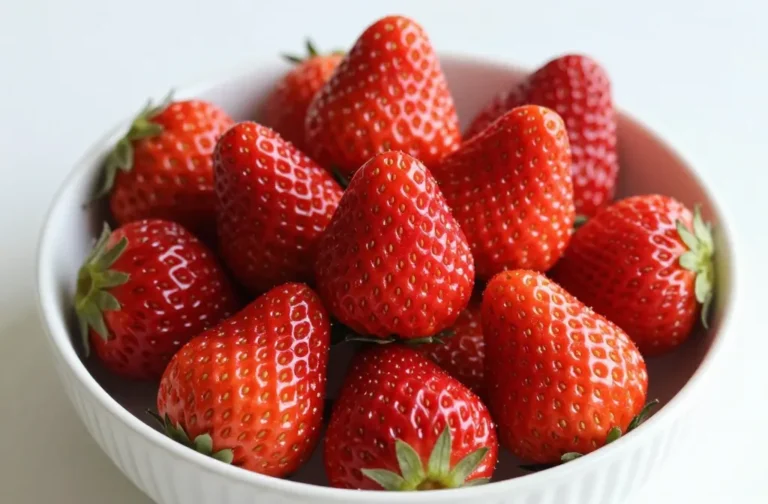
– Greek yogurt + berries + sprinkle of granola
– Whole-grain toast + avocado + salt
– Cottage cheese + pineapple
– Turkey slices + cheese + pickles
Portion it on a plate. Sit down. Enjoy. No stealth missions.
When Emotions Drive the Bus

Sometimes you don’t eat because you’re hungry. You eat because you’re tired, lonely, stressed, or bored. Food isn’t the villain here—but it can’t solve those problems either.
Build a 3-item “Instead List” for cravings:
– Step outside for fresh air
– 10 squats or a 1-minute plank (yes, really)
– Text a friend one honest line: “Craving hard. Distract me?”
FYI: You won’t pick these every time. You just need to pick them sometimes to break the loop.
Make Boring Structure Your Secret Weapon
The less you improvise, the less you overeat. Predictable beats perfect.
– Eat 3 meals and 1–2 snacks at roughly the same times.
– Pre-decide your “default breakfast” and “default snack.”
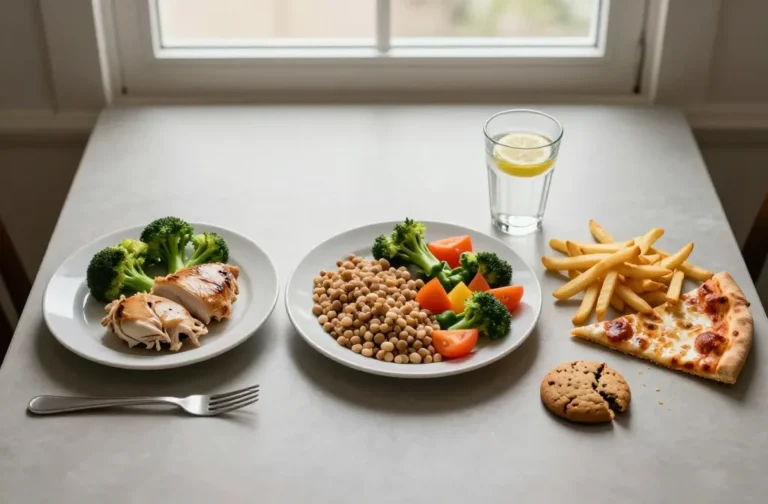
– Batch-cook a protein (chicken, tofu, beans) and a carb (rice, potatoes) twice a week.
– Keep a “green-light list” of go-to foods you actually like.
IMO: Fancy plans flop. Simple ones stick.
FAQs
How do I know if I’m doing “micro-checks” too often?
If you open the fridge or pantry more than twice between meals, or you can’t walk past the kitchen without peeking, that’s a tell. Another sign: you snack even when you can’t name a clear hunger level. Track it for one day and you’ll see the pattern.
Never Wonder What's For Dinner Again
Get 7 healthy, family-friendly dinners complete with recipes, grocery lists, and simple meal plans delivered straight to your inbox.
What if I live with other people and can’t control the food environment?
You don’t need a perfect environment—just a personal zone. Claim one cabinet or shelf that supports your goals. Use opaque bins for trigger foods and put your go-to items up front. Boundaries beat battles.
I binge at night. Will these tips help?
Yes, but start at breakfast. Front-load protein and eat consistent meals so you don’t arrive at 9 pm ravenous. Pair that with a “kitchen closed” window and one planned evening snack you actually enjoy.
Do I need to cut out my favorite foods?
Nope. Total restriction backfires. Include favorites on purpose—mindfully and on a plate. The goal is trust, not punishment.
How long until the habit changes?
You’ll feel a shift within a week if you reduce micro-checks and eat on a schedule. Deeper rewiring takes 4–6 weeks. Track small wins, not perfection.
Quick, Satisfying Recipes + Estimated Nutrition
Serving sizes noted below are estimates based on typical portions.
1) Greek Yogurt Parfait
Ingredients per serving:
– 3/4 cup plain nonfat Greek yogurt
– 1/2 cup mixed berries
– 2 tbsp granola
– 1 tsp honey
Estimated nutrition per 1 serving (about 7.5 oz/215 g):
– Calories: 210
– Total Fat: 3 g
– Total Carbohydrates: 32 g
– Dietary Fiber: 4 g
– Net Carbs: 28 g
– Protein: 17 g
2) Apple with Peanut Butter
Ingredients per serving:
– 1 medium apple
– 1.5 tbsp peanut butter
Estimated nutrition per 1 serving:
– Calories: 235
– Total Fat: 11 g
– Total Carbohydrates: 30 g
– Dietary Fiber: 6 g
– Net Carbs: 24 g
– Protein: 6 g
3) Avocado Toast
Ingredients per serving:
– 1 slice whole-grain bread
– 1/2 medium avocado
– Pinch of salt
Estimated nutrition per 1 serving:
– Calories: 220
– Total Fat: 13 g
– Total Carbohydrates: 23 g
– Dietary Fiber: 7 g
– Net Carbs: 16 g
– Protein: 6 g
4) Hummus and Veggie Plate
Ingredients per serving:
– 1/4 cup hummus
– 1 cup raw veggies (carrot sticks, bell pepper, cucumber)
Estimated nutrition per 1 serving:
– Calories: 140
– Total Fat: 7 g
– Total Carbohydrates: 16 g
– Dietary Fiber: 5 g
– Net Carbs: 11 g
– Protein: 5 g
5) Cottage Cheese with Pineapple
Ingredients per serving:
– 1/2 cup low-fat cottage cheese (1–2%)
– 1/2 cup pineapple chunks (in juice, drained)
Estimated nutrition per 1 serving:
– Calories: 130
– Total Fat: 2 g
– Total Carbohydrates: 15 g
– Dietary Fiber: 1 g
– Net Carbs: 14 g
– Protein: 12 g
6) Turkey, Cheese, and Pickles Roll-Ups
Ingredients per serving:
– 3 oz sliced turkey breast (deli)
– 1 slice cheddar cheese
– 2 dill pickle spears
Estimated nutrition per 1 serving:
– Calories: 200
– Total Fat: 9 g
– Total Carbohydrates: 3 g
– Dietary Fiber: 1 g
– Net Carbs: 2 g
– Protein: 26 g
7) Boiled Eggs and Fruit
Ingredients per serving:
– 2 large hard-boiled eggs
– 1 small clementine
Estimated nutrition per 1 serving:
– Calories: 190
– Total Fat: 10 g
– Total Carbohydrates: 10 g
– Dietary Fiber: 2 g
– Net Carbs: 8 g
– Protein: 13 g
Disclaimer: Nutrition values are estimates based on standard USDA data and common brands. Actual numbers vary with specific products, portion sizes, and preparation.
Wrap-Up: Make the Invisible Visible
The habit that keeps you stuck isn’t the big binge—it’s the tiny micro-check that lights the fuse. You don’t need more grit. You need fewer cues, steadier meals, and a couple of clutch swaps. Start with one boundary, one default snack, and one 20-second pause. Then do it again tomorrow. Small moves, big shift.
Loved This Recipe?
If you're looking for more simple, healthy dinners your family will actually eat, grab my FREE 7-Day Easy Dinner Reset. You'll get 7 easy dinner recipes, simple grocery lists, and a done-for-you plan that takes the stress out of mealtime.